AFLW 2018: End of Season Report Cards
- Mar 25, 2018
- 10 min read
The second AFL Women's season was far more even than its predecessor, with clubs rising and falling all throughout the eight-week season. With two years of development behind them and an expansion year ahead of them, where do each of the eight clubs sit?
All photos credit to Russ Canham.
Adelaide Crows

2017: 2nd (premiers)
2018: 5th
In a word: Adelaide’s 2017 flag was a miracle. Miracles are hard to bottle, particularly when two of your best players go down, your key forward kicks one goal in seven matches and the competition improves around you. Having lost marquee player Kellie Gibson to her native Western Australia in the trade period, the Crows were further weakened when reigning AFLW MVP Erin Phillips and All-Australian defender Courtney Cramey missed the first two matches through injury. Losses to Brisbane and Melbourne followed.
Throughout, coach Bec Goddard looked as if her reliance on inspiring unity in her side had been superseded by the tactical evolution of her opponents. The Crows were slow and sliced open by precise ball movement in their losses, beaten in the disposal count by an average of 54. An over-reliance on their top end was hard to deny, most notably when a Grand Final position was on the line against Collingwood in Round 7 and the Crows went from 11 points up at half time to a 21-point loss after superstar Chelsea Randall went down to injury. As disappointing as Adelaide’s fall to fifth is on paper, the Crows not only landed wins against the eventual premiers Bulldogs, Carlton and Fremantle after going 0-2 but also yielded some of the best draftees of the season in Eloise Jones and Ruth Wallace. Jones’ attack on the ball and clean hands at contests make her a more-than-promising midfielder while Wallace was often the Crows’ forward mainstay with Sarah Perkins rendered inefficient. The 25-year old Norwoodian led Adelaide’s goal-kicking with seven majors.
Grade: B
Highlight: Adelaide’s 13-point win over the Bulldogs in Round 3 was immediately hailed as one of the greatest AFLW games yet – and it has only grown in significance since then. Not only did the victory save the Crows’ season but Erin Phillips’ 15-disposal, four-goal effort in her first match back was perhaps the most staggering solo performance the competition has seen. Bulldogs’ coach Paul Groves’ grim appraisal of the reigning AFLW MVP said it best: “If that's her at 65-70% with her quad, God help everyone.” Aided by Chelsea Randall (24 touches), Eb Marinoff (21 disposals and 15 tackles) and Sarah Perkins’ surprise turn as a tagger on Emma Kearney, Adelaide stormed home after trailing for most of the match. When the Bulldogs advanced to a premiership, the enormity of Adelaide’s back-to-the-wall win was magnified.
Best & Fairest Prediction: Adelaide made the odd scheduling of having their Best & Fairest in the middle of Grand Final week rather than post-season, but there was nothing unexpected about the winner. When times were bleak for Adelaide in the first half of the season, Chelsea Randall was like St Paul’s in the Blitz. With the loss of Phillips weakening their midfield and the loss of Cramey further stretching the backline, the Crows’ co-captain was almost exclusively a defender in 2018 out of sheer bloody necessity yet her attacking play meant that she was no mere plug in defence. With her poise and willingness to take the game on, Randall turned the first line of defence into the first line of attack and averaged a competition-high 3.6 rebound 50s a game. She was also ninth for disposals and fourth for contested disposals league wide. Randall is an extraordinary athlete with sure hands both in the air and at ground level and will be one of a handful of players to record consecutive All-Australian nominations. Nowhere was her brilliance – not to mention her importance to her team - more clearly demonstrated than in Adelaide’s failed Grand Final bid against the Magpies in Round 7. Come half time, Randall had 14 touches and five intercept marks and was best afield by a country mile as the Crows held a crucial 11-point lead. However, a head injury saw her sit the match out on the pine. Collingwood piled on 5.2 to 0.2 in the second half against an opposition that had lost its heart and soul.
Melbourne Demons

2017: 3rd
2018: 3rd
In a word: For the second year in a row, the Demons were the next-best side with an embarrassing loss out of nowhere costing them a Grand Final spot. Melbourne was a kick away from fighting for the club’s first flag in 54 years but a late goal to Bulldog Brooke Lochland ended the Demons’ chances and left them rueing their Round 4 loss to Collingwood in Alice Springs.
Considering everything that went right for Melbourne, it’s hard to excuse their stagnant ladder position. Having implemented a game plan based on possession maintenance and accurate lateral ball movement, coach Mick Stinear strengthened the depth of his list in 2018. The defence ticked boxes across the board: the AFLW’s youngest veteran Katherine Smith improved on her 2017, Bianca Jakobsson looked far more composed in the red and blue than the navy blue, Meg Downie made the All-Australian squad and Richelle Cranston became a precise weapon rather than just a wrecking ball. Once again, Melbourne’s list management team were the smartest people in the room as left-of-field selections Tegan Cunningham and Kate Hore (15 goals between them) gravitated to a Batman and Robin combo up forward with ease. We’re also yet to see the best of draftee trio Eden Zanker (pick seven), Maddie Guerin (pick 14) and Claudia Whitfort (pick 30), who made the team just five times combined.
For Melbourne, the concern is their over-reliance on the ‘Darebin foursome’ of Daisy Pearce, Karen Paxman, Elise O’Dea and Melissa Hickey. Without Paxman, the Demons just hung on to beat a fast-finishing GWS. With Pearce and Hickey negated, the Demons were humbled by Collingwood. When Hickey’s Round 6 ACL injury ruled her out of the do-or-die clash with the Bulldogs, Melbourne went down. 2019 expansion sides North Melbourne and Geelong are set to take priority selections of at least two Demons, while Geelong natives Cranston, Lily Mithen and Erin Hoare will doubtless be pursued by the Cats. The onus is now on the Demons who have thus far been mere role-players to step up and become match-winners.
Grade: A
Highlight: The Demons looked like world-beaters playing on a whole other level from their competition when they thrashed reigning premiers Adelaide by 32 points in Round 1. The ball sailed across the field with speed and precision, carried by winners across every line. Paxman, Hore, O’Dea, Daisy Pearce and Mithen formed an irresistible force in the midfield as the Demons had a whopping 79 more disposals than their shell-shocked opponents. Melbourne had a dominant tall forward in Tegan Cunningham and an electric small in Aliesha Newman (two goals each). Just two matches after winning a flag, the Crows had a line put through them by some pundits on the back of that performance. It was that comprehensive.
Best & Fairest Prediction: Elise O’Dea. Although she was taken as a first-round pick in 2017, Elise O’Dea has never been a headliner of the likes of Daisy Pearce, Paxman or Hickey. And while her captain will provide stiff competition in her pursuit of back-to-back Best & Fairest Awards, the player affectionately known as ‘Junior’ was the most consistently dangerous Demon this season. Looking noticeably leaner and meaner than in 2017, O’Dea averaged nearly 18 disposals and six tackles a game, led the competition for Inside 50s and also had the most marks on any specialist midfielder with 26. After playing across half-back and wing in 2017, O’Dea found the clinches to her liking and finished in the best in all seven matches. Opposition analysts figured out that stopping any of Pearce, O’Dea, Paxman and Hickey was the key to rolling the Demons but O’Dea proved most obtuse in that regard: she polled 11, 15 and 19 disposals in her side’s losses.
Brisbane Lions

2017: 1st (runners-up)
2018: 2nd (runners-up)
In a word: The empty devastation of the Lions as they watched the Dogs lift the cup was hard to watch. For the second season in a row, Brisbane lined up all the pieces for a Grand Final appearance, were in a strong position late in the contest and got done by a miserable kick.
One suspects that it will be harder for Craig Starcevich’s side to recover for 2019. Although the ladder placement does not reflect it, the Brisbane of 2018 was a stronger and deeper side than last year. Ally Anderson and Jamie Stanton averaged 10.7 and 7.3 more touches a game respectively with the former second in the league for disposals. Jess Wuetschner became the best small forward in the game, forming the most dangerous goal-kicking combination in AFLW with heart and soul key forward Sabrina Frederick-Traub. You can put your house on a Best & Fairest Award for full back Kate Lutkins, who is the first key defender to have a genuine chance at getting the nod for the best AFL player – men’s or women’s – in God knows how long. She was wonderfully supported by Leah Kaslar, Breanna Koenen and Sharni Webb (remember, Sam Virgo is still to return to that defence). Tahlia Randall was trialled as a specialist ruck and it proved the making of her. There was no weak link in the midfield boasting Emma Zielke, Emily Bates and Kaitlyn Ashmore.
Alas, Grand Finals are cruel and fickle. Brisbane dominated the second quarter for no reward and it cost them dearly. There was no easy scapegoat who flopped on the big stage for critics to lambast but the Lions just didn’t make the most of their chances in front of goal. If there is a query over the Lions over 2018, it’s the limited opportunities given to – or perhaps earned by - their new draftees. Although Arianna Clarke (all eight games played), Sophie Conway (six) and Jordan Zanchetta (five) can bank themselves in the W-column, Kalinda Howarth, Ruby Blair, Renee Cowan and Jessy Keeffe didn’t play a game. The Tayla Harris trade didn’t prove to be a huge win for either the Lions or the wooden-spoon-winning Blues: Nat Exon was merely solid (but a hat-tip for her tagging role on Emma Kearney in the Grand Final), while Starcevich would be forgiven for thinking forlornly of his erstwhile forward as Bella Ayre ghosted her way through the Grand Final.
Grade: A
Highlight: It was a hyped build-up. When the ball was bounced in Round 7 at Blacktown, the underdog Giants were one win away from a fairytale premiership berth after finishing last in 2017. Unfortunately for them, Brisbane had no interests in attractive narratives. The Lions peaked when they needed to and pumped GWS by 40 points to win their way through to the Grand Final. All the big names came to play: Ally Anderson had 25 touches, Emily Bates and Emma Zielke led the way in the clearances while up forward Sabrina Frederick-Traub was a juggernaut, kicking three goals in the first quarter and fourth for the match. When the Bulldogs had to pull out all stops to win a taxing epic against Melbourne, it seemed Brisbane would be the fresher, hotter team come Grand Final day. Just goes to show…
Best & Fairest Prediction: Kate Lutkins. There’s something heroic about the defender who week in, week out, stands at the coalface and protects a side. In 2018, Kate Lutkins was just that. After winning Brisbane’s inaugural Most Courageous Player Award, she was the best defender in the game beyond competition and was amongst the very best players of any kind. Strong in the air, clean when repelling attacks and almost impossible to outmanoeuvre one-on-one, Lutkins had the third-highest disposals for the competition with 142, 26 of them against the Demons. She was, just quietly, robbed of being judged best afield in the Grand Final. When it mattered most, Lutkins brought her intercept and rebound game to IKON Park. Her tally of 21 touches was four more than any other player and her six marks was also a game-high.
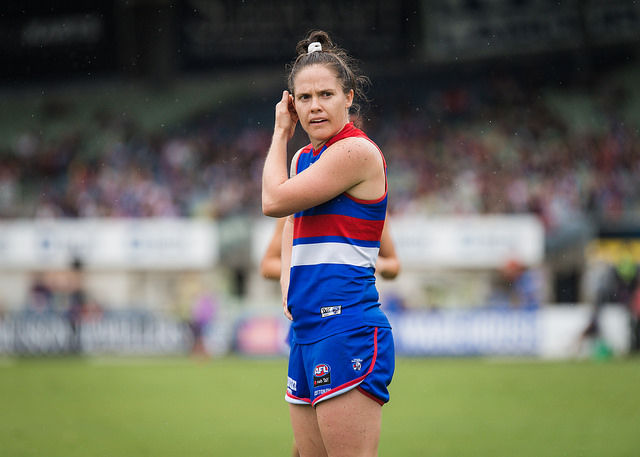
Western Bulldogs
2017: 6th
2018: 1st (premiers)
In a word: Resilience. That was what separated the Bulldogs from the rest of the pack. It’s what enabled them to brush off a disappointing 2017 season. It’s what enabled them to overcome the potential body blows of a devastating injury run. It’s what enabled them to continually win in a season where no premiership contender was immune from dropping a loss they shouldn’t have. It’s what enabled them to come back from a half time deficit in the big one and then hang on against a fast-finishing opponent. It’s what made them premiers. Elite seasons from Emma Kearney, Ellie Blackburn, Kirsty Lamb and Hannah Scott were part of the core of the Bulldogs’ on-field success but there was something to be said about how well coach Paul Groves and assistants Mick Sandry and David Bartlett developed their players. Did anyone expect both rookies in hockey player Aisling Utri and netballer Bonnie Toogood to be as good as they were? Or for Brooke Lochland to lead the goalkicking after a mediocre 2017? Or for Libby Birch to become one of the best, meanest key defenders around? Certainly, it’s hard to believe that the Dogs would make the Grand Final with great white hope Isabel Huntington and captain Katie Brennan both missing half a season – thus exposing the lack of key position players that derailed them in 2017.
Most tantalising for Bulldogs’ fans is the potential for their 2018 glory to be the beginning of a long period of dominance. Brennan, Blackburn, Birch, Lamb, Utri, Toogood, Huntington, Monique Conti, Jenna Bruton, Naomi Ferres and Daria Bannister are all 25 or younger and either elite players or have that status within their capabilities. Conti’s reputation preceded her AFLW debut by a long shot but she played every game, averaged 14 disposals and then had her finest hour in the Grand Final when she was voted best afield. If Huntington returns – and I say if, not when, because two ACLs and a broken leg by the age of 19 should make anyone rethink playing football, particularly when a very viable alternative in medicine is available – you can still expect her to be a superstar.
The last four AFL titles have been won by teams who were, at one point of the season, written off and dismissed as serious premiership threats. The Western Bulldogs of 2018 join an illustrious group of history-makers who were greater than the sum of their parts.
Grade: A+
Highlight: Grand Final day was a soggy, miserable Melbourne special that should have suited the Lions better than the fast-running, direct-playing Bulldogs. And somehow, the Dogs played that style and won the match with a three-goal-to-none blitz in the premiership quarter. Groves’ gamble on maintaining an open forward line saw Deanna Berry, Kirsten McLeod (a late-in for the controversially suspended Brennan) and Monique Conti convert goals and open up a 13-point lead that proved flag-winning. An edge-of-the-seat last quarter forced the Dogs to defend rather than attack and defend they did with Kearney kicking the sealing goal and Lauren Spark terrific in a day not suited for rucks.
Best & Fairest Prediction: Emma Kearney. A superhuman ball winner who is one of a handful of players capable of single-handedly turning a match, Kearney won more possessions than any other player, led the metres gained statistic by a whopping 748 with 3368 and is set to feature very prominently in the AFLW MVP votes. The sight of Kearney fighting her way out of packs to tear along the wing and laser the ball Inside 50 was burned in the mind of fans. To maintain that level of performance on such a consistent basis was gobsmacking: consider that Kearney’s lowest disposal count in a match was 13 while she topped her side’s disposals in their losses against Adelaide and GWS. Running alongside Ellie Blackburn, Kearney was half of perhaps the most dangerous partnership in AFLW across any club or line.


Comments